 Ocean BreezeApr 29, 20255 min read
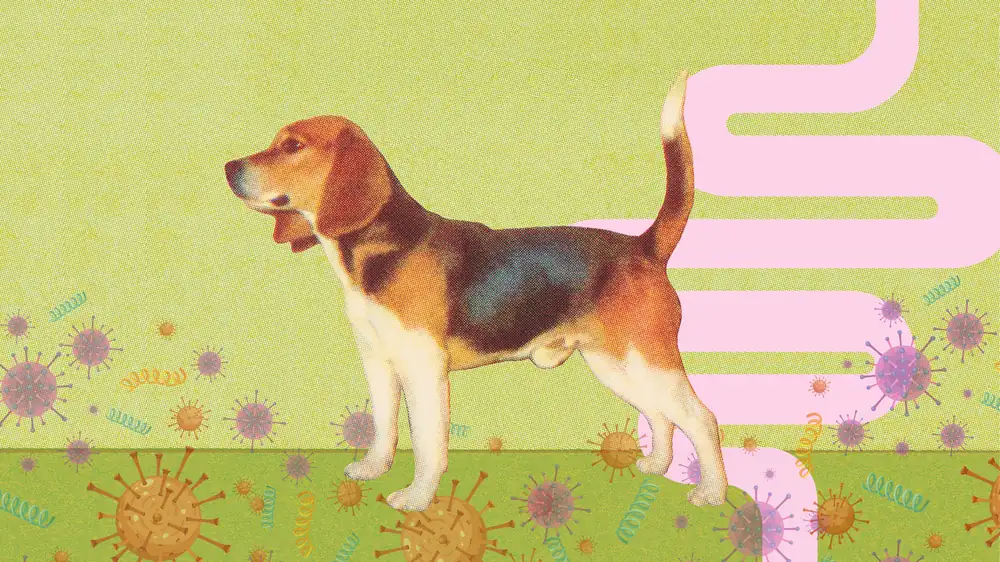
(Photo: Beagle: CSA Images/Getty; Graphic Collage: Ayana Underwood/Canva)
All dog lovers know that those furry friends improve your quality of life. They cheer you up when you’re feeling down, keep you active, and help foster connections with your communities. But did you know that having a pup might also be good for your gut?
It’s hard to imagine, but research is showing that owning a pet could be beneficial for your gut microbiome, and thus your gastrointestinal health.
Clostridium difficile, orC. difficile,is usually a hospital-acquired andinfection-causing pathogenthat disrupts healthy bacteria in the colon. The infection, known asC. diffcolitis, tends to occur when patients take antibiotics, which can kill good bacteria in the gut.
As many as30 percentof patients initially treated for infections experience a recurrence, and the risk of subsequent recurrence only increases with each case, leading to an unpleasant cycle.
Laurel Redding, an associate professor of epidemiology at the University of Pennsylvania School of Veterinary Medicine, wondered if these recurrent cases might come from the animals we share our environment with.
“The idea going in was, if you getC. difficilefrom the hospital, you come home, you shed it, your pet would pick it up, your pet would become colonized, then your pet would give it back to you, and you would become infected again,” Redding says.
But her team found quite the opposite. Their2020 studyexplained that close interactions with pets actually appeared to have aprotective effectagainst the recurrence of C.difficileinfections.
Other researchers have observed similar phenomena. A2024 studyfound that children between the ages of 5 and 15 who lived with a dog had a reduced risk of developing Crohn’s disease, a bowel disease that causes inflammation of the intestinal lining.
A2016 studyfound that exposure to dogs led to a decrease in childhood asthma cases in farming communities. Research also found thatin seniors(people over 65), there was an increase in beneficial microorganisms and a decrease inharmful bacteria in the guts of dog owners. Findings in anotherrecent studysuggested that exposure to pet dogs (and not cats, interestingly enough) decreased the prevalence of atopic dermatitis, also known as eczema, in children, especially when the dogs remained indoors.
“People who grew up around animals, or had furred pets, or grew up on farms tend to have lower incidences of autoimmune diseases like asthma oratopy(which describes someone who is highly susceptible to allergen-related diseases), and even obesity,” says Redding. She explains that a lot of these diseases are tied to the health of the microbiota, the community of organisms that live on and in our bodies, primarily in the gut, which is home to roughly100 trillion bacteria—hence the focus on gut health.
Beginning as early as the 1980s, researchers have found that pets and their owners share microorganisms.A1984 studyspecifically looked at intestinalE. coliand found that humans and their pets shared similar strains of the bacteria.More recent studies, however, analyze whole communities of microorganisms. One2013 studyfound that people and dogs who cohabitated shared similar microbial communities.
Children who live in households with pets have higher gut diversity than those who don’t reside with pets, and the thought is that a more diverse microbiome is a healthier microbiome.
According to Redding, “Up until recently, the majority of the research looking into microbes from pets has been more on the pathogen side where we question: What are the bad things that animals transmit to us?” But researchers are starting to understand that microbial sharing might have benefits.
The reasonwhythere are fewer instances of allergies or autoimmune diseases in farming communities or households with animals remains unclear. But many researchers believe it is linked to the hygiene hypothesis: the idea that young children in clean, modern environments are not exposed to an adequate amount of microbes, resulting in understimulated immune systems (and making them more likely to develop allergies and auto-immune diseases). Dogs may help with that.
“Children who live in households with pets have higher gut diversity than those who don’t reside with pets, and the thought is that a more diverse microbiome is a healthier microbiome,” saysDr. Lori Holtz, a pediatric gastroenterologist at St. Louis Children’s Hospital and member of the American Gastrointestinal Association. “The thought is that dogs go outside and bring those microbes in.”
During Redding’s 2020 study, researchers found that more contact came with greater benefits. “The more contact you have with your pet, the more you share sleeping quarters with it or let the dog lick your hand or face, the greater the protective effects againstC. difficileinfection recurrence,” she says.
Don’t worry: you don’t necessarily need to change your behavior around your pets to reap the benefits. “Generally, I think with people who own pets, there’s a lot of close contact, so that kind of exchange is just happening already,” says Holtz.
Moststudies on the beneficial impacts of pet ownership on the microbiome have been conducted with young children and babies, a time when themicrobiomeismost malleable. But Redding is currently studying adults to see whether older pet owners have less severely disrupted microbiomes after taking antibiotics and if their microbiomes recover more quickly.
“Everyone has a baseline microbiome that’s healthy enough, but when something like an antibiotic comes along and disrupts it, then it will be interesting to see what effects our pets might have, if any,” says Redding.
We Don’t Know How Many “Bad” Germs Our Pets Share with Us
While studies around microbial sharing are promising, experts note that more research is necessary.
“We still do have to weigh the possibility that they are sharing unhealthy microbes with us, likeCampylobacter(a bacterium that causes diarrhea) or Salmonella orE. coli,” says Redding. “So where that trade-off happens, good bacteria versus bad bacteria, I don’t think we know at this point.”
Between eating fermented foods, managing stress, getting enough sleep, and following all of the other gut health tips out there, keeping your microbiome strong can seem like a daunting task. But luckily, the gut-healthy practice of snuggling up with your pup is easy to incorporate.
Want more ofOutside’s Health stories?Sign up for the Bodywork newsletter.