 Ocean BreezeMay 29, 20256 min read
For hikers, every day isleg day—which makes mastering the best stretches for hiking an essential step.
Hiking uses your gluteal muscles, quadriceps, hamstrings and calves, and requires sturdiness of all the joints—ankles, feet, hips, and knees. Carrying a pack can create tension in your neck and using hiking poles can cause your arms to become sore.
Fortunately, targeted stretching before and after each hike can prevent injury and aid in recovery. A 2021 survey of studies published inWilderness Environmental Medicine Journalshowed that yoga and stretching were associated with less injury for hikers.
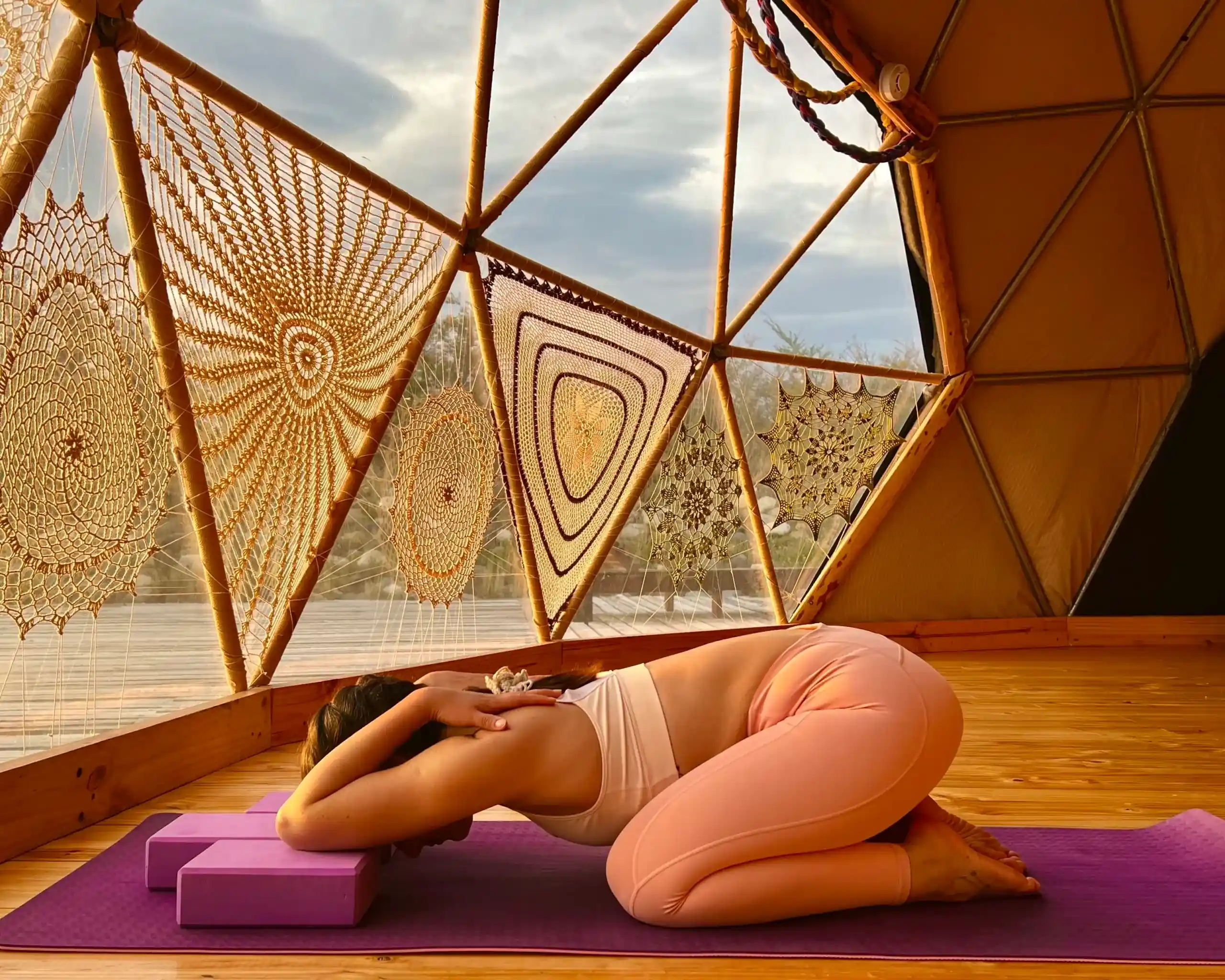
While trekking in Patagonia, I sometimes wondered if my legs would evernotfeel sore again. After each day of 15-mile hikes, I returned toEcoCampto practiced yoga in the designated yoga dome.This daily practice gave my body the opportunity to recover with more ease and grace, rehydrating my muscles and freeing the lactic acid build-up. The following day’s hikes were met with less resistance in my joints and more intention in each step.
Try this series of stretches for hikes after (or before, or preferably both!) your next on-foot adventure. You’ll be impressed at how much faster you will recover from those long miles of uphill climbs.
After miles on the trails, your entire body can feel tense and achy. Starting your post-hike practice inChild’s Poseinvites relaxation into your nervous system and musculature. You can also open up your chest by propping your elbows and forehead on blocks, bending your elbows, and placing your fingertips on your shoulders. This also adds a stretch for the triceps, which can become sore from using hiking poles.
After a day of hiking, especially if you have been carrying a big pack, some spinal decompression can be greatly appreciated, and this can be accomplished by any kind of inversion, includingDownward-Facing Dog. It’s a fairly accessible inversion that provides gravity-driven lengthening for yourspine. It also stretches your wrists and calves. If your calves feel particularly sore from going up and down the mountain, roll a blanket and place it under your heels for some extra support.
When hiking, we often stare downward at the trail, which increases strain on the muscles that hold our head upright. Moving your cervical spine gently in every direction, as well as offering some traction can help ease any ongoing neck pain.Kneel on the mat and sit back on your heels, with your shins on the ground and knees hip width apart.(Place a block under your hips if you feel discomfort in your hips, knees or ankles). Sit tall and offer yourself some neck stretches.
Cat/Cow is one of my favorite poses to help you get back in touch with the integrity of your spine and to thoughtfully reconnect with your breath. The protraction and retraction of the shoulder blades can also ease soreness from wearing a backpack.The rhythmic motion of this pose helps to gently loosentight musclesalong the entire spine and open space in the back of your shoulders.
Thehip flexorswork hard while you’re hiking, helping you lift your leg with each step forward.Tight hip flexorscan decrease your stride length and cause your gluteus muscles to overwork, so you want to keep them as flexible and fluid as possible. Low Lunge is a great pose to relieve tightness and bring balance in the front and back of your hips. To add some chest opening, raise a climbing pole above your head and reach your arms back slightly behind your ears.
Anyone who has hiked a mountain knows how much of a toll that takes on the quadriceps. This version of Low Lunge is a staple stretch for all hikers, and yet one we often neglect. Bring your foot closer to your buttocks for a deeper stretch, or away from your buttocks for more focus on the hip flexor. Place a blanket under your knee for additional support. Reaching back to grasp your foot also provides an additional stretch for the chest and front shoulder.
Your hamstrings work in conjunction with the quadriceps to bend your knees while you walk, and they’re especially important when you are climbing. Hamstring health is integral to hiking because they have to lengthen considerably when the knee extends and the hip flexes as the foot contacts the ground. If you have tight hamstrings, your knee won’t extend properly which will impact your gait, often causing knee, hip or back pain. Practicinghalf splitsis a great way to access hamstring opening, while also controlling how deeply you stretch. Place blocks under your hands ifyou prefer more back and gluteal lengthening. For an additional stretch for your shin muscles, press the sole of your front foot toward the ground.
Warrior Iis often thought of as a strengthening pose for the hips and legs, and it is. However, the positioning of the back leg also provides a stretch for the hip flexor, hamstring, and calf muscles. For a little less work in your front leg back out of the knee bend a bit. (It’s true, your front thigh doesn’t have to be parallel to the ground all the time, especially if your legs are tired from hiking!) A nice add-on to this pose is to bring your hands into reverse prayer or fist-to-fist. This gives a stretch to your shoulders and chest.
Let’s talk buttock muscles: Our glutes do a lot of work for us day in and day out–and they are literally built to help get hikers uphill. When we factor in the force of gravity and a heavy backpack, this greatly increases the work on the gluteus muscles and quadriceps in comparison to walking on a flat surface. To counter that workload,Pigeonis a great posture to stretch your buttocks muscles. To provide an additional stretch of your quadriceps in your back leg, bend your knee and draw your heel toward yourglutes.
Hikers commonly have tight IT bands, and this rigidity can often manifest as lateral knee pain–pain on the outside of the knee. If the gluteus muscles are too tight, (see Pigeon above), this can cause the IT bands to become even tighter.Half Lord of the Fishespose is a nice way to relieve tightness in the IT band, while also providing a chest opening spinal twist.
If you hike fast, your ankles may be in a perpetually dorsi-flexed position. This can cause tightness in your tibialis anterior (your shin muscles), which can also cause ankle instability. Stretching the fronts of the lower legs will not only help you stay on the trails with a healthier stride, but it also feels so good. If this pose feels too intense in your knees or ankles (see neck stretches above), sit on a block for support. Also, a nice add-on, which stretches your triceps and forearms, is to bring your arms intoGomukhasana, using your hiking poles instead of a strap to help your hands reach each other.
When we hike, we are often so busy taking in the scenery or watching our step that we often forget to breathe in the beautiful forest or mountain air. Take a moment to practice some breathwork to remind yourself to stay fully open, present, and awake to all you’ve accomplished, and all that is to come.